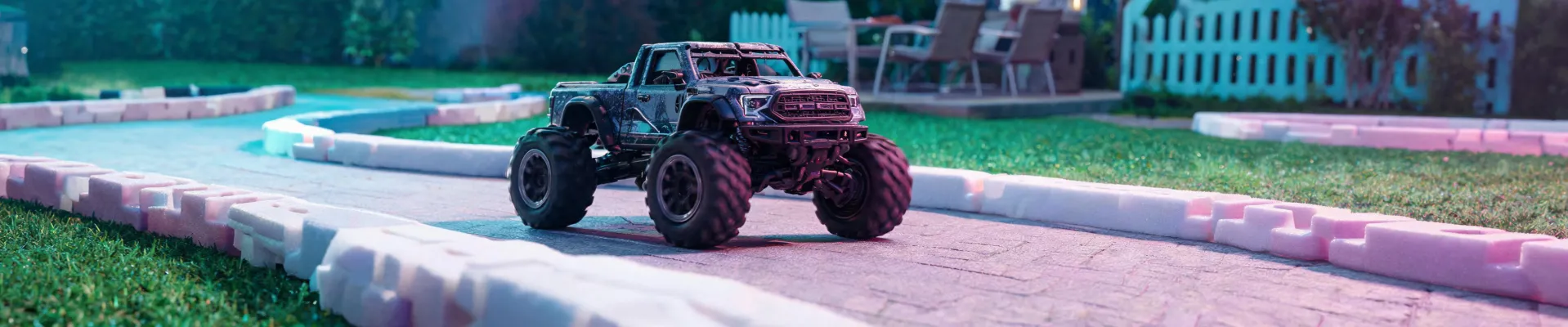
Arrma Vorteks 223S BLX 4x4: A High-Value Brushless Truck With Conditions
Posted on 2026-08-24 by Miriam Adler
Should you buy the Arrma Vorteks 223S BLX 4x4 because it's fast, or because it fits the ground you actually drive on? The spec sheet makes 4x4 and brushless sound like a universal upgrade, but the reality is far more situational. If your weekend runs are on short grass or packed dirt, the 223S's traction and power make those surfaces fun. If you're stuck with a smooth parking lot, the 4x4 system just adds weight. Name your dominant terrain first—that answer, plus your willingness to maintain it regularly, decides whether this is a high-value brushless truck or an overbuy.
What terrain will you actually drive on?
What does your typical running spot look like? If it's short grass or packed dirt, the 4x4 system will help you power through the thicker patches and control slides on corners. If it's a smooth concrete court, all-wheel drive becomes extra weight that dulls acceleration. Separate 'terrain you'd like to drive on' from 'terrain you will drive on this month.' A truck that only shows its strengths at a skate park is still a good buy if that skate park is your venue. The real condition that makes 4x4 worth it is loose or uneven ground—not a flat strip of asphalt.
Here is how the layout changes with the running surface. A short-course truck with 4x4 sends power to all four corners, which is why it feels planted on medium-rough terrain. On short grass, the front wheels pull through turns; on packed dirt, they add grip when the rear wants to slide. The Vorteks 223S uses a composite chassis and an adjustable slipper clutch, and those parts matter more than headline speed. The slipper lets you tune power delivery—loosen it for low grip, tighten it for high grip. On smooth lots, that same system adds complexity without benefit. So a truck that feels composed on grass can feel twitchy on concrete, not because of the motor but because of chassis dynamics.
Condition: your terrain decides whether this truck is a tool or a toy. If you regularly run on grass, dirt, or skate parks, the 223S is a high-value brushless short-course truck. If you only have a parking lot, a lighter 2WD gives more fun per dollar and fewer parts to maintain. List the last five places you drove an RC car: if even one involved loose dirt or grass, 4x4 pays for itself. If all five were smooth pavement, it fails the first test. That's a mismatch, not a flaw in the truck.
Brushless power vs. battery life: the real tradeoff
The brushless system runs on 3S LiPo packs, creating a genuine triple tradeoff: speed, acceleration, and runtime. With 3S, the motor can push the truck to roughly 45 mph out of the box, but speed draws current heavily. A typical 5000mAh 3S pack gives 20–25 minutes of hard bashing, less if you're running at full throttle. A 2S pack cuts top speed by about a third but stretches runtime toward 30 minutes and improves control on low-grip surfaces. The 3S label doesn't mean 3S is always the right choice—it means you have a range of styles to choose from.
Here is where the decision really sharpens. If you value acceleration and will buy multiple 3S packs, the 223S delivers a thrilling experience. If you're on a budget, 2S makes the truck calmer and costs less—but leaves performance unused. Battery choice also affects maintenance: 3S packs need storage charging, and lithium degrades if left full. The real question isn't 'can it handle 3S?' but 'will I store and charge packs correctly?' Unless you already own a good LiPo charger and safe storage, factor that cost in. That's the condition: treat the battery as part of the system.
The tradeoff becomes clearer with acceleration vs. top speed. Many buyers fixate on max speed, but on a bashing loop, acceleration and control matter far more. The 4x4 drivetrain puts power down evenly, helping corner exits, but it also means more parts to inspect: driveshafts, diffs, and the slipper clutch. Getting the slipper right is the difference between hooking up and shredding spur gears. The powertrain isn't just a spec—it's a system you'll tune. If that sounds like a project, the 223S is a great project; if you wanted a no-thought basher, the maintenance section decides.
Maintenance: the cost nobody puts in the box
Here's the condition that changes the buying equation: you must accept that a brushless truck is not zero-maintenance. The 'BLX' badge makes it look like a toy, but underneath it's a hobby-grade machine spinning at tens of thousands of RPM. After every dusty run, chassis, bearings, and drivetrain need attention. Skipping cleaning lets dust mix with oil and grind like paste. The most reliable way to extend any brushless RC's life is routine care: blow out the chassis, inspect screws, and clear debris from driveshafts and diff cases. Neglect and you'll replace bearings and spur gears months early.
How much time do you actually have for this? Maintenance is a rhythm, not a one-time setup. After a hard day at the skate park, expect ten to twenty minutes of cleaning and checking—longer if you ran in wet grass. The question is whether that feels like a chore or part of the hobby. In my view, drivers who get the most from the 223S enjoy the ritual: wipe down, check the slipper, verify the drivetrain turns freely. If you'd rather run and then ignore the truck until next weekend, you'll have fun but shorten its life. That trade is invisible on day one and obvious by month six.
Research on precision equipment makes the same point: cleanliness and consistent care are the most reliable way to prevent premature wear. The evidence isn't about RCs specifically—it's about how documentation and hygiene protect any mechanical system. When a maintenance guide says clean the parts, skipping it compounds over time. For the Vorteks, follow Arrma's own manual, not forum hearsay. If a source says 'never needs maintenance,' cross-check the official spec sheet. If it says 'always clean after dusty runs,' that aligns with the principle. The catch is doing it regularly—after every significant run, not monthly. Only then does the 223S deliver the durability it's known for.
Who should buy it, who should not
Now apply a simple binary filter. Who should buy the Vorteks 223S? You should if you drive mixed terrain, want a truck that grows with you, and accept cleaning and tuning time. You should not if your budget can't cover a good 3S charger and at least two batteries, or if you only have a smooth parking lot. The deciding factor is that you're buying a system, not a vehicle. If you already own 2S packs and a charger, the 223S fits your budget. If starting from zero, entry cost is higher than the price tag—that's where many overpay for unused capability.
The key step is verifying the actual specs on Arrma's official product page before committing. Forums and aftermarket sellers often repeat numbers that contradict factory ratings—some say 6S, others claim higher speed. The evidence here reflects a broader pattern: specs passed along without checking official documentation get amplified. Even well-intentioned guides can be wrong from secondhand info. So open Arrma's page, write down the key figures, and treat those as the baseline. That act filters out most hype. If the official page says 4x4 and 3S-capable, base your decision on that, not a forum post.
The final rule: three questions before you click buy
Before you click buy, run through these three questions. First: what terrain will you drive on this week? Grass, dirt, or a skate park means 4x4 makes sense; pavement only means it doesn't. Second: are you ready to buy at least one good 3S pack and a charger, and store it at partial charge? If no, stick to 2S and a slower truck. Third: will you clean the truck after each dusty session and check the drivetrain? If yes, the 223S lasts years; if no, budget for parts. The rule works only if you answer yes to all three. Miss any one, and a cheaper 2WD basher becomes more logical.
This simple three-question rule works for any similar RC truck because it separates performance claims from ownership reality. The Vorteks 223S isn't the only fast brushless 4x4; its value lies in balance and parts support, which appears only when your use case matches the design. Final judgment: buy it only if terrain rewards 4x4, budget includes proper batteries, and habit includes regular cleaning. If all three hold, it's a high-value truck that rewards years of bashing. If any fails, you're paying for capability you won't use—a cheaper 2WD or slower battery-focused truck serves you better.
The rule isn't 'which truck is fastest?' It's 'does this truck fit your ground, your batteries, and your care?' Run the three answers through the filter before paying. When terrain matches, the charger is in your cart, and you're ready to hose the chassis after a dusty run, the 223S is the right buy. When any answer wavers, step back and reconsider. That's not a compromise—it's the difference between owning a tool you use and storing a promise you don't.

Miriam Adler
Miriam Adler is an educational and STEM toy analyst specializing in busy boards, Montessori-style manipulatives, learning towers, sound books, reading pens, pretend-play sets, and early learning toys. She applies ASTM F963 and IEC 62115 methods while evaluating small-part hazards, accessible edges, switch durability, sound output, battery access, pull force, and age-appropriate task complexity. Her work helps parents, retailers, and product teams choose learning products that align developmental goals, supervision needs, interaction design, and the intended age stage.
Leave a Reply