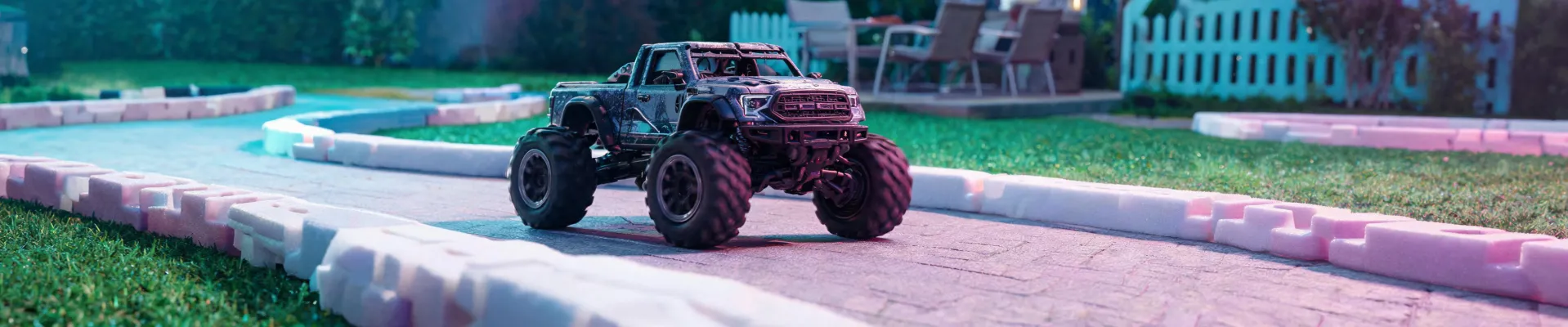
ARRMA Typhon 4x4 RTR Brushed Buggy: A Buyer's Guide to Specs, Versions, and Maintenance
Posted on 2026-08-27 by Miriam Adler
-
Typhon 4x4 RTR Brushed Buggy: The Direct Answer
-
How to Confirm the Specs Against Official ARRMA Documentation
-
The Timeline: How the Typhon RTR Line Has Changed
-
Common Misconceptions: Brushed Power and RTR Readiness
-
Three Steps to Verify a Genuine Current Version
-
Maintenance Baseline: Cleaning, Lubrication, and Inspection Frequency
-
Final Verdict: Who Should Buy the Typhon 4x4 RTR Brushed Buggy?
I get the question all the time: is the ARRMA Typhon 4x4 RTR Brushed Buggy worth it? The short answer is yes, provided you are a beginner or a parent buying a first RC car for a child, and provided you verify the version and part numbers against ARRMA's official documentation before you pay. This is a 1/8-scale, ready-to-run, brushed buggy built for durability and easy maintenance, not for record-breaking speed. The brushed motor gives you smooth, controllable torque that suits off-road bashing on uneven ground, and the RTR label does not mean zero setup — you still have to check gearing, shocks, and the slipper clutch before your first run. If you skip that step, you may end up with an outdated or counterfeit unit, which is why official specs matter more than any sales page.
Typhon 4x4 RTR Brushed Buggy: The Direct Answer
The Typhon 4x4 RTR Brushed Buggy is ARRMA's entry point into 1/8-scale off-road driving. 'RTR' means ready-to-run, so the box includes the transmitter, battery, charger, and the car itself, but that does not mean it is perfectly tuned. The lineage of the Typhon line goes back several years, and the brushed version sits below the brushless models in both price and top speed. What it sacrifices in straight-line speed, it makes up in low-end torque and straightforward electronics. For a driver who is new to the hobby, the car's durable composite chassis, oil-filled shocks, and sealed differentials make it a practical first buggy that can take a beating without requiring constant repairs. The parts are widely available, and the layout is simple enough that a first-time owner can replace a shock or a spur gear in an evening. That simplicity is deliberate: ARRMA designed this model to be a learning platform, not a race car.
The natural audience is a parent buying a first serious RC car for a child, or an adult who wants to learn bashing without a steep learning curve. Because the brushed motor delivers power linearly rather than in a sudden surge, you can modulate throttle through corners and over bumps with far more control than a punchy brushless system. The car is also easier to service: there are fewer electronic components to worry about, and basic maintenance like cleaning and re-greasing the differentials can be done with simple tools. If your goal is tearing across a parking lot at maximum speed, this is not the model for you. If your goal is a durable, repairable, and predictable off-road toy that your family can enjoy, the Typhon brushed fits that role. It is the kind of car that encourages you to take it apart, understand it, and put it back together without fear.
How to Confirm the Specs Against Official ARRMA Documentation
Before you buy any ARRMA model, confirm four parameters: the scale, the drivetrain, the power system, and the exact contents of the RTR package. The scale is 1/8, the drivetrain is 4x4, and the power is a brushed 550 motor, but the exact part numbers and included accessories change between revisions. Independent review sites and comparison charts can give you a general idea of what to expect, and they are useful for ranking popular models. However, they cannot tell you which version of the Typhon you are looking at or whether a listing includes the latest transmitter. For example, an early version might use a NiMH battery and a different receiver, while the current version ships with a LiPo-compatible ESC and a newer transmitter. These differences are invisible in a product title but obvious in the spec table. That level of detail lives only in the official specification sheet and the user manual, so those documents must be your final authority.
The reason official confirmation is so important comes down to how product lines evolve. Standards change: a part that was listed as standard in an early manual may become an optional extra in a later revision, and a seller's title may still describe the original version. In the broader RC industry, guidelines and recommended practices are often updated after incidents or consumer feedback, which is why the latest official document always reflects the current state. If you rely on a product description that says 'Typhon 4x4' without a version number, you risk receiving old stock that lacks the updated drivetrain components or the revised battery tray. Checking the official ARRMA site and comparing the product number, manual date, and spec table will eliminate that risk. This is not a hypothetical problem; it happens every time a model is revised, and the only way to know which revision you are holding is to check the documentation. Treat the sales copy as a starting point, not proof.
The Timeline: How the Typhon RTR Line Has Changed
This is why knowing the RTR standard matters: it has shifted significantly over the past decade. In the early days, an RTR package often meant a basic car with a cheap radio and a NiMH battery, and users were expected to do a fair amount of assembly and tuning. Manufacturers gradually moved toward more complete packages, but the term still implied that you could run the car straight out of the box. For 1/8-scale buggies, the trend has been toward brushless systems, which offer higher top speeds and longer runtimes with LiPo batteries. This created a gap at the entry level: a brushless RTR can be intimidating for a new driver because of its instant throttle response and higher maintenance demands. By the mid-2010s, most 1/8-scale RTRs had switched to brushless, and the entry-level segment was left with few durable options. That gap is where the brushed Typhon still makes sense.
Today, the brushed version of the Typhon exists precisely because that gap remains. Parents and hobbyists who want a 1/8-scale car without the cost or complexity of brushless electronics still need a durable platform. ARRMA kept the brushed option in the lineup as a way to offer the same chassis and suspension as the brushless models at a lower price. The trade-off is obvious: the brushed motor tops out at a lower speed, and the included NiMH battery needs to be replaced with LiPo only if the speed controller supports it. But for the intended use case — learning, bashing on grass or dirt, and repairing your own car — the brushed version is not a compromise; it is a deliberate choice that keeps the hobby accessible. The aftermarket support for the brushed version is also strong, with replacement parts shared across several ARRMA models, so you will not struggle to find spares. That ecosystem makes it an even safer first purchase.
Common Misconceptions: Brushed Power and RTR Readiness
Many first-time buyers assume that a brushed motor is simply weak and that any brushless system is automatically better. That assumption misses what matters in off-road bashing. A brushed 550 motor produces torque in a linear curve, meaning the power builds smoothly as you pull the trigger. That characteristic makes the car easier to control when you are navigating loose gravel, tall grass, or uneven dirt. A brushless motor, by contrast, delivers its power in a more aggressive surge, which can cause wheelspin and loss of traction if you are not experienced. The real difference is not raw power but how that power is delivered. For a beginner driving on uneven terrain, linear torque is more controllable and less likely to end in a crash. The brushed system also costs less to replace, so a beginner can make mistakes without worrying about a hundred-dollar speed controller.
The second misconception is that RTR means zero setup. In reality, every RC car needs a pre-run check. The factory settings are a baseline, not a final tune. Before you run the Typhon for the first time, you should check the gear mesh, confirm the shock oil levels, and adjust the slipper clutch so it does not slip too much or bind. You also need to charge the battery properly and confirm the transmitter bind the first time. Skipping these steps can lead to stripped gears, overheated electronics, or a car that handles poorly. The RTR label simply means that the car is assembled and includes the parts needed to run; it does not mean it is optimized for your driving conditions. The manual contains a specific checklist, and following it is part of owning the car. That checklist is short, but it prevents expensive mistakes.
Three Steps to Verify a Genuine Current Version
To verify that you are getting the current genuine version, follow a three-step protocol. First, locate the product part number on ARRMA's official website and compare it with the one on the box and the chassis. The part number is the single most reliable identifier because it changes when the manufacturer updates components. Second, download the latest user manual and check the publication date and the molded part numbers it references. Manuals are updated alongside the product, so a current manual will list the same part numbers you see on your car. Third, cross-check the specification table against the physical contents: the transmitter model, battery connector, pinion gear size, and included tools. Official guidelines exist for every stage of this process, and following them step by step is the only way to avoid being misled by a seller who has not updated their listing. This mirrors the kind of checklists that official sources publish for routine maintenance: they exist to protect you from assumptions.
Some red flags should immediately make you walk away. If a listing does not show a version number or a part number, treat it with suspicion. If the seller cannot provide a photo of the manual's front page or the spec table, that is another sign the product may be old stock or a counterfeit. And if the price is significantly below the official MSRP , be cautious — a 'too good to be true' deal usually is. The risk of ignoring official guidance is real: when you skip the spec confirmation, you can end up with a car that has outdated electronics or missing parts. Following the official guidance is not just bureaucratic; it is the difference between a working toy and a project that requires immediate repairs. For example, a missing manual page or a generic box photo are easy ways for sellers to hide the age of the product. Take the extra minute to ask for those details.
Maintenance Baseline: Cleaning, Lubrication, and Inspection Frequency
Every RC car, including the Typhon, needs a simple maintenance baseline. After each run you should blow off or wipe down the chassis to remove dust and debris, paying special attention to the shock shafts and the area around the slipper clutch. Once a month, or every ten runs, remove the wheels and check the hexes, bearings, and drive shafts for wear. The manual lists the lubrication points and intervals, typically for the differentials and the gearbox, and it also specifies which parts need periodic inspection. You should also check the slipper clutch tension and the gear mesh after the first few runs because they will settle with use. Official cleaning and inspection standards exist for exactly this reason: a neglected car will fail in ways that are easy to prevent with a few minutes of attention. Following the manual's checklist is cheaper than replacing a stripped spur gear or a burned-out motor. Keep a small brush and a can of compressed air near your workbench, and the whole process takes ten minutes.
Maintenance standards also change over time. Manufacturers occasionally release updated versions of their manuals, and they may publish service bulletins when a component needs to be checked or replaced. Independent testing sites and community forums can help you stay current, but they are not the same as official announcements. If you follow the brand on social media or check the official website a couple of times a year, you will catch updates about revised torque specs, new battery recommendations, or recalls. Ignoring those updates is a risk: a car that was reliable last season may need a different slipper pad or a reinforced gearbox this season. The official channel is the place to look for those changes, because unofficial rankings and reviews can be outdated or based on older hardware. A quick registry check or a manual download can save you from installing a part that was superseded. Treat the manufacturer as the source of truth.
Final Verdict: Who Should Buy the Typhon 4x4 RTR Brushed Buggy?
After walking through the specs, the lineage, and the maintenance routine, the verdict is clear: the ARRMA Typhon 4x4 RTR Brushed Buggy is a strong buy if you are new to the hobby, on a budget, or buying for a young driver who wants a real RC car rather than a toy-grade machine. Its durability, easy maintenance, and linear torque make it the right tool for learning how to drive off-road. You should not buy it if your top priority is maximum speed or if you already have experience with brushless systems and want a car that can compete at club level. For the entry-level buyer, this car delivers exactly what the category promises: a ready-to-run platform that you can learn on, repair yourself, and eventually upgrade or sell as you progress. But the verdict only holds if you verify the version and part numbers first, because an old or counterfeit unit will turn that strong buy into a headache. The official spec sheet is the tiebreaker, and the manual's pre-run checklist is your first repair lesson.
To make the decision even more concrete, here are the boundaries. If your child is under eight and has never driven an RC car, you may want to consider a smaller 1/16 or 1/18 scale model instead, because the 1/8 Typhon is fast enough to be intimidating for very small hands. If you plan to race competitively, the brushed motor will hold you back; a brushless 1/8 buggy is the right choice, even though it costs more. If you live in an area with extremely dry, dusty conditions, prepare to clean the car after every outing, because the open gearbox and exposed driveshafts will pick up debris. And if you find a deal that is 20% off the normal price but the seller cannot confirm the part number, walk away — that discount is usually bait for old stock or counterfeit parts. The Typhon brushed is a great first car, but only when you buy the right version and treat the manual as the operating standard. These boundaries apply regardless of how good the price looks.
The brushed Typhon is a teacher, not a toy. Buy it for the control it teaches you, the repairs you will learn to do, and the version check that keeps you honest. That combination is what makes it the right first 1/8-scale buggy for a parent, a beginner, or anyone who wants a car that is meant to be learned on.

Miriam Adler
Miriam Adler is an educational and STEM toy analyst specializing in busy boards, Montessori-style manipulatives, learning towers, sound books, reading pens, pretend-play sets, and early learning toys. She applies ASTM F963 and IEC 62115 methods while evaluating small-part hazards, accessible edges, switch durability, sound output, battery access, pull force, and age-appropriate task complexity. Her work helps parents, retailers, and product teams choose learning products that align developmental goals, supervision needs, interaction design, and the intended age stage.
Leave a Reply