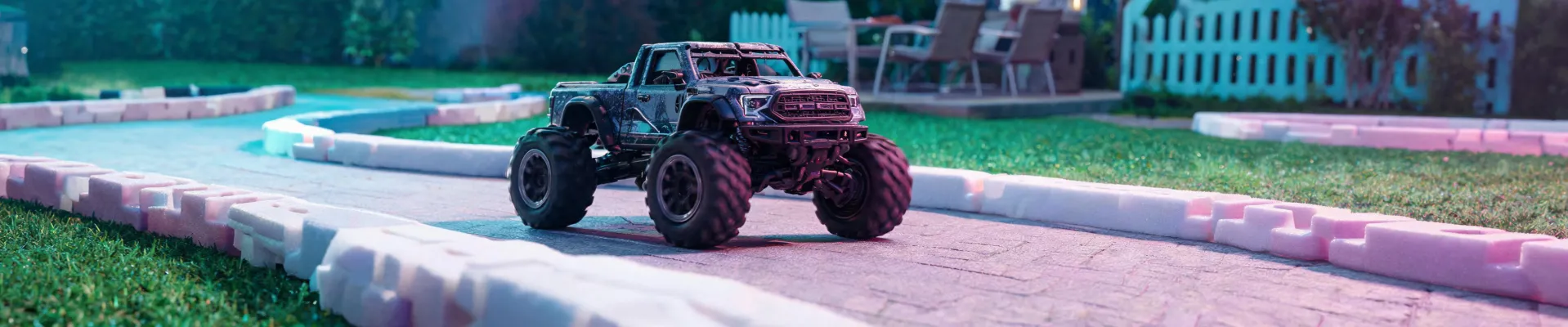
ARRMA Mojave GROM 4X4 BLX Brushless: The Complete Buyer’s Guide for Mini Truck Fans
Posted on 2026-08-20 by Miriam Adler
-
The Short Answer: Yes, the Mojave GROM 4X4 BLX Delivers
-
223S BLX Power and 4X4 Platform Explained
-
Brushed vs Brushless: What the Extra Spend Buys You
-
How It Feels on Grass and Gravel, and How Tough It Is
-
Which Version to Buy and What to Get With It
-
The Final Verdict: Who Should Buy and Who Shouldn't
The ARRMA Mojave GROM 4X4 223S BLX Brushless is the best-value mini brushless short-course truck you can buy right now. It delivers big-truck power in a 1/18 package that’s tough enough for backyard bashing, and its 223S BLX system gives you smooth, controllable speed—not just a straight-line rocket. If you want a ready-to-run 4x4 that won’t empty your wallet and leaves room to grow, this is it.
The Short Answer: Yes, the Mojave GROM 4X4 BLX Delivers
The Mojave GROM 4X4 BLX is worth buying, and it's the model you should choose if you want a small, tough truck you can run on grass, dirt, or gravel without constant repairs. Many people assume a 1/18-scale vehicle is just a toy—slow and fragile—but the 223S brushless system pushes this truck past 40 km/h, while the 4WD drivetrain keeps it planted on loose surfaces that would spin out a 2WD toy. That combination changes what you can do in a typical backyard: instead of crawling around at walking pace, you're carving corners, powering through leaf piles, and catching small jumps with confidence. For buyers with a budget between roughly $150 and $220, this is the most balanced option in its class—provided you want a ready-to-run truck that can be upgraded later. If your budget stretches at all, skip the brushed version and get this one; the performance difference is huge, and you won't have to buy a second car when you outgrow the beginner model.
This truck is not for everyone, and that's okay. It's best for drivers who want a manageable-size RC that delivers real speed and handling in a small space—your driveway, a park path, or a dirt patch behind the garage. If you're a parent buying for a young child (say, under 10), or if you expect a maintenance-free toy that can take full-speed crashes into concrete walls, this is the wrong pick. Independent product evaluations across categories consistently show that products designed for honest, real-world use outperform those that chase spec-sheet numbers; the GROM's 1/18 size is honest about its purpose, which is agile bashing on loose surfaces, not hardcore racing or extreme jumping. As long as you match expectations to its scale—and treat it as a serious mini truck, not a toy—you'll find it fits a very specific, very fun slot in your RC collection.
223S BLX Power and 4X4 Platform Explained
The 223S BLX is a brushless power system designed to be both punchy and smooth. Unlike a brushed motor, it has no carbon brushes to wear out, which means fewer replacements and more consistent power over its life. The system runs on a 2S LiPo out of the box, giving you around 22 minutes of run time if you drive with any sense; if you're heavy on the throttle, expect less, but that's normal for any RC. What makes BLX different from a basic brushed setup is the low-speed linearity: the throttle response is precise from a crawl to full speed, so you can finesse the truck around obstacles instead of just gunning it. The included ESC also gives you programming options—you can dial in brake strength or throttle curve—which is rare at this price point. When you're ready for more, the same system accepts a 3S battery, pushing speed past 50 km/h and run time toward 30 minutes if you keep the gearing sensible. Just remember that the faster you go, the more you'll need to keep the drivetrain clean; a quick wipe-down after dusty runs keeps the bearings happy, a principle that applies to any performance vehicle.
The 4X4 chassis is the other half of the story. Four-wheel drive gives you traction when the surface gets loose, and the Grom platform keeps the truck compact without making it flimsy. The wheelbase is short, so it can turn on a dime, and the suspension is tuned for small bumps; on rough grass, it doesn't porpoise like longer trucks often do. The chassis is a molded plastic tub with metal driveshafts and oil-filled shocks, and that's a sensible combination for a 1/18 truck—it keeps weight low and maintenance easy. The size also makes it practical: you can fit it in a backpack and drive in spaces that would bore a 1/10-scale truck. The best way to keep it working well is to follow the official setup and maintenance guidance; tightening screws after the first few runs and checking the shock oil levels will prevent most issues. For a mini truck, durability is about smart design rather than sheer mass, and the GROM's platform uses plastic where it should flex and metal where it needs strength.
Brushed vs Brushless: What the Extra Spend Buys You
To decide whether the brushed or brushless version makes sense for you, you need to compare them on the same scale: power, run time, control, maintenance, and total cost. The brushed Mojave GROM is cheaper, but it uses a conventional 380-size brushed motor with an ESC that gives you just one speed profile. The brushless BLX, as we've covered, brings a more efficient motor, adjustable ESC, and the ability to run 3S later. The real question isn't which one has a higher top speed—it's how each truck behaves in the places you'll actually drive it. Below, we'll walk through the key trade-offs so you can see where your money goes.
After you line up the numbers, the extra money for the BLX buys more than speed. The brushed version will do maybe 20 km/h and run for 15 minutes on a fresh charge; the brushless more than doubles that speed and extends run time by about 50% on the same 2S pack. More importantly, the brushless motor's lack of commutator wear means you're not replacing motors after every season, which is a real cost saving over time. The trade-off is upfront price and a little extra weight from the larger ESC, but that weight sits low and actually improves handling. For the majority of buyers, the brushless version is the better long-term value. The only case where the brushed car makes sense is if you're buying for a very young child who will likely break things before they outgrow the platform, or if your budget simply cannot stretch—but then you should also plan to drive more gently and maintain the drivetrain regularly, since worn parts are more likely to affect a brushed motor's reliability. In the long run, the cheapest upfront option often costs more—a lesson that holds across many product categories.
How It Feels on Grass and Gravel, and How Tough It Is
On the driving experience, the BLX's low-speed control is what separates it from a toy-grade RC. You can crawl the truck at a walking pace without cogging, then squeeze the throttle and it surges forward with a smooth, linear power band. That linearity makes it easier for a new driver to learn throttle control, and it’s a big reason why the truck feels more expensive than it is. The 4WD system also gives you confidence in corners: you can brake into a turn and power out without spinning out, which is exactly the kind of forgiving behavior a beginner wants. On short grass, the truck stays composed; on gravel, you get a little slide but it's controllable. One widely understood principle is that good handling comes from consistent, predictable behavior, and this truck delivers that because the ESC programming is set up conservatively from the factory. You can also adjust it later if you want more aggression.
Durability is where the GROM platform earns its reputation. The chassis is a single-piece tub that flexes on impact rather than cracking, and the body is a tough polycarbonate shell that can take a decent hit. When something does break—usually a suspension arm or a hinge pin—replacement parts are cheap and widely available, and the design uses common screws rather than proprietary fasteners. You can do most repairs with a basic hex driver in under 15 minutes. The importance of straightforward maintenance is a recurring theme in consumer product guidance: if you can't easily fix it, you won't, and then it becomes a paperweight. Here, the truck is designed to be repaired quickly, which means you can spend more time driving and less time waiting for parts. A product that's easy to service tends to last longer because owners actually perform the upkeep.
Which Version to Buy and What to Get With It
When you choose a version, the main decision is between the standard RTR (ready-to-run) and the BLX brushless. If you're starting from zero, the BLX RTR is the one to get—it includes the transmitter, receiver, and a 2S LiPo, so you just need a charger. Some retailers sell a 'rolling chassis' without electronics, which makes sense if you already have a transmitter and battery from another RC. For most people, though, the BLX RTR is the right call because it's balanced out of the box and doesn't require any soldering or setup. If you're on a strict budget, the brushed RTR is acceptable for a first car, but you may quickly want an upgrade; buying the BLX from the start avoids that second expense. The same logic applies to choosing between 2WD and 4WD: 4WD costs a bit more, but the off-road stability is worth it for the typical grass-and-gravel use case.
For batteries, pick up at least one extra 2S LiPo with an EC3 or IC3 connector, and a charger that balances cells—a cheap balance charger is fine. The stock 2S pack gives you about 22 minutes, so a second pack doubles your session without waiting. If you plan to run 3S later, buy a 3S pack with a lower capacity (like 1000mAh) to avoid cooking the ESC, and check the manual for the right gearing. You'll also want a basic tool set: hex wrenches, a small Phillips screwdriver, and some silicone oil for the shocks. These extras add up to roughly $100–$150 beyond the truck itself, but they're all reusable if you own other RC vehicles. The key is to match the battery connector and discharge rate to what the manual specifies—that's the same 'check the official spec' advice, and it prevents costly mistakes.
The Final Verdict: Who Should Buy and Who Shouldn't
Final verdict: the ARRMA Mojave GROM 4X4 223S BLX is a clear buy for the casual to intermediate basher who values a compact, capable truck. It earns its keep because it delivers genuine performance—40+ km/h, smooth control, and a durable chassis—without demanding a large indoor or outdoor space. If you're a serious racer looking for a competitive scale truck, or someone who prefers 1/10-scale presence and larger jump capability, you'll find this too small. Similarly, if you're buying for a child under ten and want something that survives full-speed collisions with walls, no 1/18 truck will be truly armoured; you're better off with a toy-grade model that's slower and lighter. For everyone else—the person who wants to bash in the backyard after work, or take a truck to the park on weekends—this is the sweet spot.
Here's a reusable decision rule you can apply to any RC purchase: if your primary use is quick, low-maintenance fun on grass and dirt within a modest budget, choose the smallest vehicle that offers 4WD, a brushless motor, and a reputation for durability. The Mojave GROM fits that rule perfectly; a 1/10-scale truck might exceed it, but you'll pay double and need much more space. Conversely, if you require extreme speed or hardcore jumping, this rule points you to a larger platform. The rule works because it forces you to match the vehicle to your actual driving environment, not to a spec sheet fantasy. And remember, the official manual and setup guide are your first source of truth; following the manufacturer's care instructions will keep your investment running for seasons.
When choosing any RC, match the vehicle to your real driving space, budget, and skill level—that rule points most backyard and park drivers straight to the Mojave GROM 4X4 223S BLX.

Miriam Adler
Miriam Adler is an educational and STEM toy analyst specializing in busy boards, Montessori-style manipulatives, learning towers, sound books, reading pens, pretend-play sets, and early learning toys. She applies ASTM F963 and IEC 62115 methods while evaluating small-part hazards, accessible edges, switch durability, sound output, battery access, pull force, and age-appropriate task complexity. Her work helps parents, retailers, and product teams choose learning products that align developmental goals, supervision needs, interaction design, and the intended age stage.
Leave a Reply